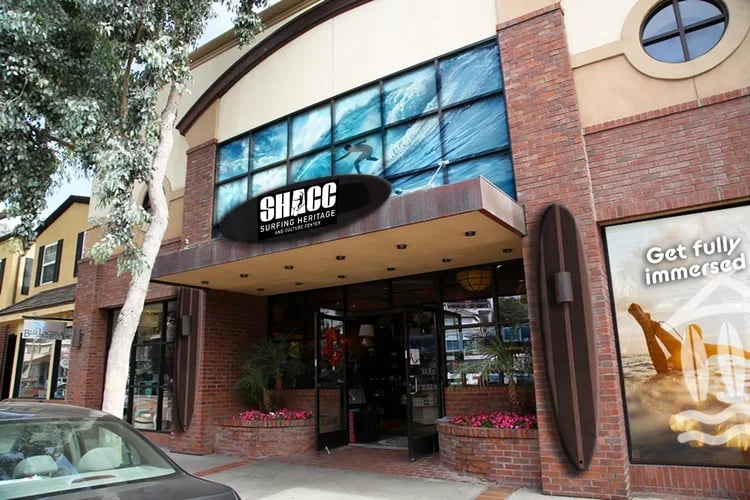
"All of a sudden, I'm back in Laguna," Dick Metz said last week, standing in a building 200 yards from the sand at Main Beach. "I've done this whole 360-degree turn, and I ended up back at Main Beach in Laguna."
Metz is in his mid-90s and he founded the Surfing Heritage and Culture Center, the archive now nicknamed the Smithsonian of Surf. On September 18, he cut the ribbon on its new home at 239 Broadway. Most of the coverage this week is treating that as an opening. It isn't. It's a return, and the twenty-plus years in between explain why this particular stretch of downtown matters more than any press release lets on.
A Museum That Started in a Walk-Up Office Two Blocks From Here
Before SHACC had a formal name or a nonprofit filing, it had a walk-up office in downtown Laguna Beach in the late 1990s, where Metz and curator Barry Haun shared a walk-in closet as their makeshift headquarters. Metz had spent thirty years running Hobie retail stores in Hawaii, where he became friends with Duke Kahanamoku and his brothers, and along the way he kept collecting old boards because, in his own words, they carried "tons of sentimental value." When he connected with fellow collector Spencer Croul, the two combined archives and the project outgrew that closet fast.
That growth is the whole story of what happened next. A collection that starts in a shared closet either stays small or it leaves town, and this one left town.
Twenty Years in Costa Mesa and San Clemente, Then a Change of Address
SHACC moved first to a Costa Mesa warehouse, then settled into a building in San Clemente in the mid-2000s, where it operated for more than two decades. Executive Director Jeff Alter, who is also the son of surfboard-shaping legend Hobie Alter, described that location plainly: it sat in an industrial area, near the offices of local surf magazines, useful for storage but not for foot traffic. "The site is substantially larger and more public-facing," Alter said of the new Laguna building. "I think we'll get a lot more energy."
The San Clemente location closed to the public in October 2025 to prepare for the move. What replaced it isn't a bigger warehouse. It's a downtown storefront that residents already know, whether they knew its name or not.
What Actually Fills 12,000 Square Feet on Broadway
The new building itself has a Laguna Beach history that predates surfing's arrival there by nothing at all. It dates to 1941, when it served as a Sprouse Reitz five-and-dime, the kind of store every beach town used to have one of. Today it holds roughly 12,000 square feet, split between about 9,500 square feet downstairs for exhibits and events and 2,400 square feet upstairs for offices, storage, and archives.
What's inside those 9,500 square feet is the largest collection of historic wood surfboards anywhere, drawn from an archive of more than 500,000 objects, images, and pieces of surf ephemera. More than twenty boards ridden by former and current world champions are on display. In the front window sits a re-creation of Dale Velzy's original shaping shack, tools and unfinished board included, a nod to the shaper who popularized the Malibu Chip and got his start working under the Hermosa Beach Pier. And near the entrance is a board with a more personal story: the hand-me-down Metz got as a teenager from George "Peanuts" Larson, the first board he ever rode, now on permanent display in the town where he rode it.
Why the Address Isn't a Coincidence
Laguna Beach's connection to surfing predates SHACC by a century, and it runs through a specific wave a few miles down the coast. In the 1920s, Duke Kahanamoku, already a three-time Olympic gold medalist, was working in Hollywood and staying in Laguna Beach, spending his off days at his favorite break near Corona del Mar. That proximity is a large part of why Laguna became one of California's earliest surfing hubs, decades before the sport had a museum to preserve it. Metz grew up here in the 1930s, learning to surf on heavy redwood boards with no fin, and he opened SHACC's first office here before the collection had anywhere else to go.
Putting the archive back on Broadway isn't a marketing choice. It's the same short list of streets and beaches where the story it tells actually happened.
What Comes After the Ribbon Cutting
For a town that already carries a lot of cultural weight, from its art festivals to its long environmental fights over the coastline, a surf museum landing two blocks from Main Beach fills a gap that wasn't obvious until it was filled. Laguna Beach has told its art history for decades through the Festival of Arts and the Pageant of the Masters. It hasn't had a comparable home for its surf history, even though that history is older and arguably just as central to how the town sees itself.
Metz put up part of the cost himself, selling his home in Idaho and a piece of property in Laguna to help fund the purchase of the building. That's not the kind of detail that shows up in a grand opening press release. It's the kind of detail that tells you what this move actually meant to the person who made it happen.
If you've lived in Laguna long enough to remember when the surf archive was still a rumor in a walk-up office, or if you've only ever known it as a reason to drive to San Clemente, the version on Broadway now is the one that was supposed to exist the whole time. It just took twenty years to get back.
We follow stories like this one closely, not because they move listings, but because they're part of what makes Laguna Beach worth paying attention to in the first place. Marcus Skenderian Real Estate has spent generations in this community, and understanding what's opening on Broadway is part of the same local fluency we bring to understanding what a property on that same street is actually worth. If you're ever curious where your home stands in this market, we're glad to help.