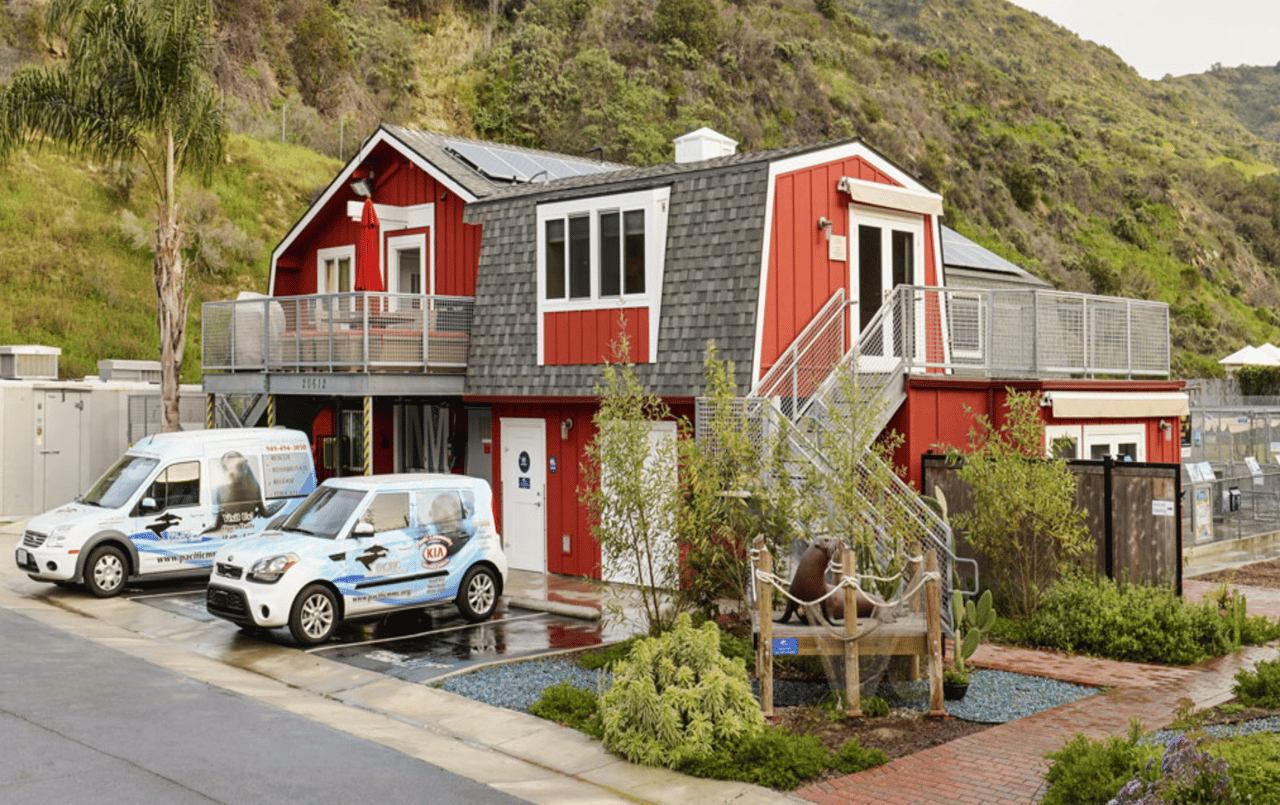
At the entrance to 20612 Laguna Canyon Road there's a bronze sea lion circling through kelp and fish. It's Casey Parlette's In Pursuit, and it was modeled on a former patient named Potato. Parlette spent years as a Laguna Beach lifeguard. The piece honors the center's founders, its stewardship and the town's lifeguards. Through the gate are ten new pools, a treatment suite with a public viewing window, and a 5,000-gallon pool with an underwater window.
There were no sea lions in any of them on opening day.
Designed by architect, and cousin, Todd Skenderian, The Pacific Marine Mammal Center opened its rebuilt Bob Barker Visitor Yard and Teaching Hospital to the public on Monday, Oct. 12. It's open daily from 10 a.m. to 4 p.m., and Stu News Laguna reported that the center had no animals in-house "due to seasonality of rescues." On reopening week, PMMC's own Our Patients page showed zero current patients. The center reopened in the slowest part of its rescue year, a few weeks before its busy season usually starts.
October is the quiet stretch of PMMC's year
The center says so itself. In the FAQ on its Plan Your Visit page, PMMC names late winter and early spring as its busiest rescue season. That's when pups are weaning from their mothers and are most prone to malnourishment and dehydration. It expects more pups to come in from November through April, and adds that ocean conditions like domoic acid and El Niño or La Niña can change that pattern in any given year.
NOAA Fisheries explains what drives the cycle. In a 2015 feature, the agency noted that three-month-old pups still depend on their mother's milk, and that pups in poor condition point to mothers who aren't finding enough prey near the rookery. A March 2026 NOAA feature ties recent stranding events to ocean warming and less available prey. That means the size of each spring's intake is mostly decided offshore, months before any animal shows up on a Laguna beach.
The numbers show how much intake swings from year to year. PMMC reported 290 patients rescued in 2024. As of early October 2026, Stu News listed 146 rescues and responses for the year: 102 sea lions, 16 fur seals, 9 cetaceans, 8 elephant seals, 7 sea turtles and 4 harbor seals. In bad years the spike is extreme. In summer 2023, PMMC's response to a domoic acid bloom passed 100 affected patients within weeks. During the 2013 to 2016 Unusual Mortality Event, the center logged a record 1,500 California sea lion rescues.
A hospital rebuilt for its busiest months
The center had seven small pools before the project. It now has ten new ones to raise capacity and support rehabilitation. The campus is sized for a spring surge, not the October count.
Interim CEO Blair Contratto listed the additions at the reopening gala. According to Stu News Laguna, they include:
- Nicholas W. Gross Family Underwater Viewing Pool: a 5,000-gallon pre-release pool with a noninvasive underwater window, made possible by The Sue J. Gross Foundation.
- A 10,000-gallon rehabilitation pool, made possible by Marilyn Green.
- New Patient Treatment Suite, with a viewing window that lets visitors see clinical work, plus a dedicated necropsy space that expands post-mortem research and sample collection.
- Massen Greene Education Center, a new 1,600-square-foot classroom that doubles capacity for on-site programs.
- MacGillivray Media Center & Studio, funded by Greg and Barbara MacGillivray, which adds broadcasting for distance learning, the speakers' series and presentations.
- Center for Collaboration, a 2,000-square-foot shared building. It houses an expanded Laguna Beach Animal Shelter, a communication center for the Laguna Beach Police Department and the Orange County Sheriff's office, PMMC's new Necropsy Suite, its Development Office and the John Kinney Reception Deck.
The building with the most local significance is the Jeff & Carla Meberg Water Reclamation Center. The old pools were cleaned and refilled three times a day, which made PMMC the second-highest water user in the city of Laguna Beach. The center spent $5 million on the 2,000-square-foot recycling facility. It's expected to reclaim nearly 5 million gallons a year, about 90% of the center's total use. The water bill climbs with the patient count, so this building matters most during the busy months.
What an empty yard lets you see
With the pools empty, the art and architecture are the main attraction for now. Besides Parlette's statue at the entrance, the campus has:
- TAG's Dolphin and Elephant Seal Pool Mural, designed by local artist Chris Barela and hand-painted by Emma Crespo and Jordan Tacker, two 2024 Drawing + Painting graduates of Laguna College of Art + Design. It honors Marilyn Green and her husband, Terry, who loved elephant seals.
- The Massen Greene Education Center mural, with underwater marine mammal scenes designed and painted by Laura Frost, PMMC's Distance Learning and After School Programs Coordinator.
- Mike Tauber's "Friends of the Sea Lions" tile wall, with hand-painted tiles from more than 100 PMMC donors.
- The Promise, a bronze whale sculpture mounted on the Water Reclamation Facility. The Pacific Life Foundation donated it in 2024 to honor the center's education and cetacean response programs.
Admission is free. Reservations aren't required, but PMMC encourages them. The yard is closed on Thanksgiving, Christmas Eve, Christmas Day and New Year's Day, and when weather requires it. Those holiday closures fall inside the first stretch of the pup season. PMMC suggests checking its Patient Portal to see who's in-house before visiting. PMMC typically sees more pups coming in from November through April, though ocean conditions shift that timing from year to year, so the portal is the way to check whether animals are in the hospital before you go.
Fifty-five years, three of them behind a closed gate
The center was dark during three of the busiest seasons in its recent history. It started in 1971 as Friends of the Sea Lion, run by three volunteers: Jim Stauffer, John Cunningham (one of Laguna Beach High School's all-time favorite teachers) and Dr. Rose Ekeberg. The rebuild took several phases:
- March 1, 2023: groundbreaking ceremony for the expansion, as reported by the Laguna Beach Independent.
- Oct. 22, 2023: the visitor yard closed to the public.
- October 2023 to October 2026: construction on the $20 million project, according to PMMC's expansion page.
- Oct. 12, 2026: public reopening, open daily.
Rescues didn't stop during the closure. PMMC credits ongoing community support with keeping its 2024, 2025 and 2026 rescues and responses going throughout the three-year project. At the anniversary gala, auctioneer Zack Krone led a live auction and paddle raise that brought in more than $500,000 for operations and the remaining construction costs. The center also gave its first PMMC Founders Award to Director of Animal Care Michele Hunter, its longest-serving employee at 37 years, who has cared for an estimated 7,000 patients.
Stephanie Cunningham, the founder's wife, explained the reason for all the classroom and viewing space in remarks reported by Stu News Laguna:
"John believed that education was the key to creating people who cared and those people would make a difference. Looking around today, I think we can see just how that vision has come to life."
When the season reaches your beach
Many of this winter's patients will be found by people walking local beaches. PMMC's rescue line is 949-494-3050. The center asks callers to describe the animal's location and the terrain, any visible injuries, its size and body condition, its behavior, and any tags or markings. PMMC also points out that seals and sea lions often haul out just to rest. Its guidance is to stay back, watch from a safe distance, keep other people away, and never touch, feed, harass or move the animal or pour water on it.
Releases happen on local beaches too. Once a patient passes its pre-release exam, PMMC has to release it within 14 days. Animals are driven to a local beach in the early morning, and whenever possible at least two seals or sea lions are released together to help them watch for predators and find food. PMMC's busiest stretch usually runs from late winter into early spring.
Marcus Skenderian has spent his career around architecture, construction and the city approvals that shape projects like PMMC's rebuild in Laguna Canyon. If you're weighing what your property might support, or what it's worth this season, Marcus Skenderian Real Estate can talk it through with you. Request a Complimentary Home Valuation.