Laguna's coastline earned its postcard reputation from rock. Shaw's Cove, Crescent Bay, the tide pools below Heisler Park, the reef-cut shelf at Goff Cove: these are the coves that show up on every "best beaches" list, the ones with stairs cut into the bluff and mussel beds waiting at low tide. That same geology is exactly what keeps grunion away from most of Laguna's shoreline. The fish need something Laguna's famous coves don't offer: long, flat, unbroken sand.
The 2026 grunion season closes August 31, according to Grunion.org, the Pepperdine-affiliated research group that tracks the species along the Southern California coast. That gives residents about three weeks left before the run disappears until March. Anyone spending those nights parked above a rocky cove waiting for silver flashes in the surf is watching the wrong stretch of coast, no matter how good the view is for everything else Laguna does well.
What a Grunion Actually Needs From a Beach
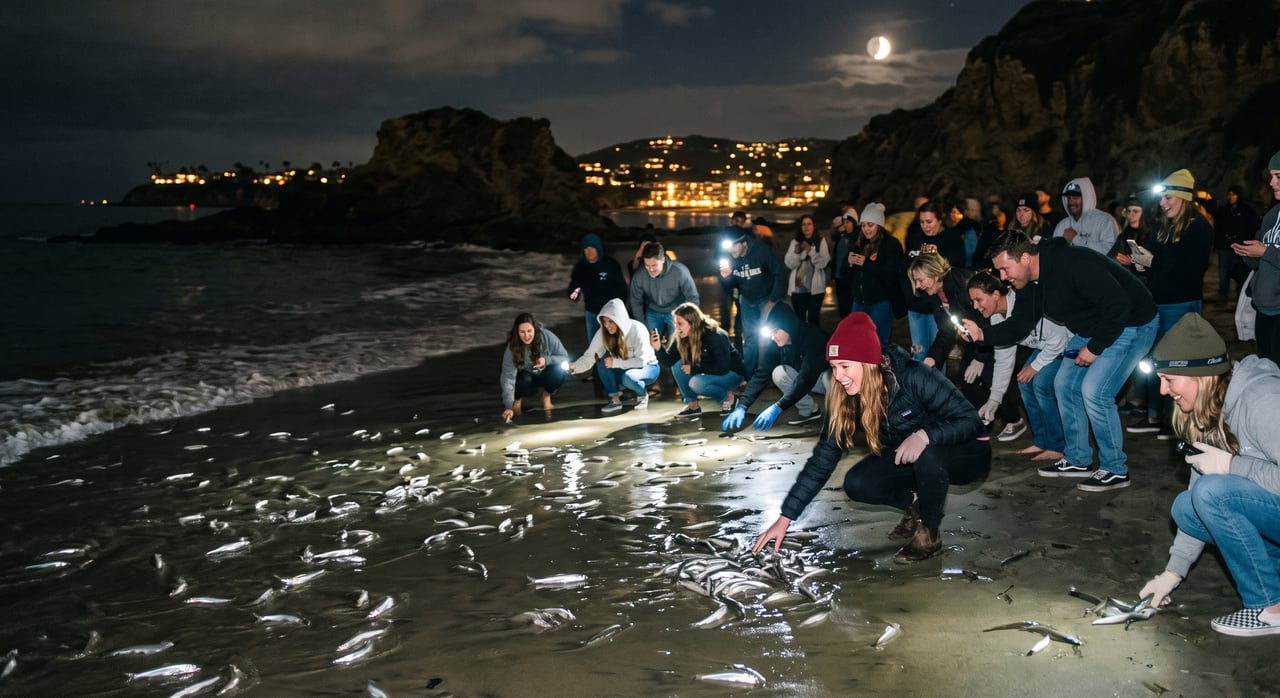
California grunion are small silverside fish, typically five to seven inches long, and they're the only species that comes fully out of the water to spawn. Female grunion ride the highest tides of the new and full moon onto the sand, dig in tail-first, lay roughly 3,000 eggs, and wait for males to fertilize them before the next wave carries everyone back out. The eggs stay buried for ten to fourteen days until a later high tide washes them free.
None of that works on a rocky shelf. The fish come ashore on beaches described by researchers as quiet, minimally lit, sandy rather than rocky, and gently sloped rather than steep. A cove full of exposed reef and boulders at low tide, the exact terrain that makes Laguna's snorkeling and tide-pooling spots so good, gives grunion nowhere to dig in and nothing but turbulence to fight against.
Where the Coves Fail and the Sand Wins
Laguna's rocky-cove reputation is well earned. The best-known tide pool spots in town are Rockpile Beach, Shaw's Cove, and Crescent Bay, with Goff Cove and Treasure Island close behind. Every one of them is reef-protected, which is precisely why they're wrong for spawning fish and right for everything else Laguna does at low tide.
The beaches built for grunion sit elsewhere in town. Main Beach, the broad, southwest-facing stretch of sand at the foot of Broadway and Coast Highway, is described in tourism materials as an above-average sandy beach in a wide cove, the kind of open, gradually sloping terrain grunion actually use. Thousand Steps Beach in south Laguna is likewise sandy rather than reef-lined, even though the stairs down to it discourage casual visits. These two beaches, not the postcard coves, are where a grunion run in Laguna Beach is biologically plausible.
This is worth sitting with for a second. Laguna's shoreline is not uniform. A town famous for its rocky drama has a narrow band of true sand tucked between the points, and that narrow band is the only part of the coast doing this particular job in August.
The Nights Left This Season
Grunion don't spawn on a fixed calendar. They follow the tide cycle around each new and full moon, running for three or four consecutive nights per cycle, typically in a two-hour window that starts after the evening's highest tide. Researchers at CDFW consistently note that the second hour of that window tends to produce better viewing than the first, and that the second and third nights of a four-night cycle are usually stronger than the bookend nights.
The department doesn't publish a beach-by-beach forecast for Laguna specifically, but it does publish the season's expected run nights and times, updated year to year. With the season ending August 31, the runs remaining in 2026 will cluster around whichever new or full moon falls before that date. Checking the current schedule directly on the CDFW site, rather than relying on last year's dates, is the only way to know which nights are worth the walk down to Main Beach or Thousand Steps this month.
For a sense of how close the season already is to wrapping up elsewhere on the coast, California State Parks' public grunion program at Bolsa Chica lists sessions running through August 29, 2026. That's not a Laguna date, but it's a useful marker: the institutions built around this ritual are treating late August as the closing stretch, not the middle of the run.
The Rules for the Nights You Do Go
August falls inside the open season, which means catching grunion by hand is legal, not just watching them. Anyone 16 or older needs a California sport fishing license with an ocean enhancement validation. Catches are hand-only, no digging holes to trap fish, and the daily limit is 30 grunion per person. None of this matters if you're just there to watch, but it's worth knowing before someone in your group starts scooping with a bucket.
A Dog-Friendly Loophole at Main Beach
Here's a detail that gets overlooked even by people who've lived in Laguna for years. Main Beach bans dogs from 9 a.m. to 6 p.m. between June 15 and September 10, which covers exactly the stretch of summer when the beach is busiest during the day. But grunion runs happen well after that window closes, typically starting between 9 p.m. and midnight depending on the tide. Outside the 9-to-6 restriction, dogs are allowed on leash. A late grunion walk at Main Beach is one of the only times this summer you can bring a leashed dog to the town's most central stretch of sand without breaking a city rule.
Why the Distinction Matters Beyond This Month
Laguna's coastline rewards people who know which stretch does what. The coves that make this town look the way it does in every photograph are not interchangeable with the sand that makes this particular seasonal ritual work. That's true of grunion in August, and it's true in smaller ways all year: the beach for tide pools isn't the beach for a bonfire, the beach for snorkeling isn't the beach for a dog walk after dinner. Knowing the difference, rather than defaulting to whichever cove is closest or most photographed, is most of what separates a long-time resident's routine from a visitor's itinerary.
With three weeks left before the season closes for the year, that distinction has a deadline attached to it for once.
Coastal knowledge like this, the kind that comes from actually walking this shoreline for years rather than reading about it, is the same instinct we bring to evaluating the homes along it. If you're weighing a move within Laguna Beach or want a clearer read on what a specific stretch of coast is really worth, Marcus Skenderian Real Estate is glad to talk it through.